



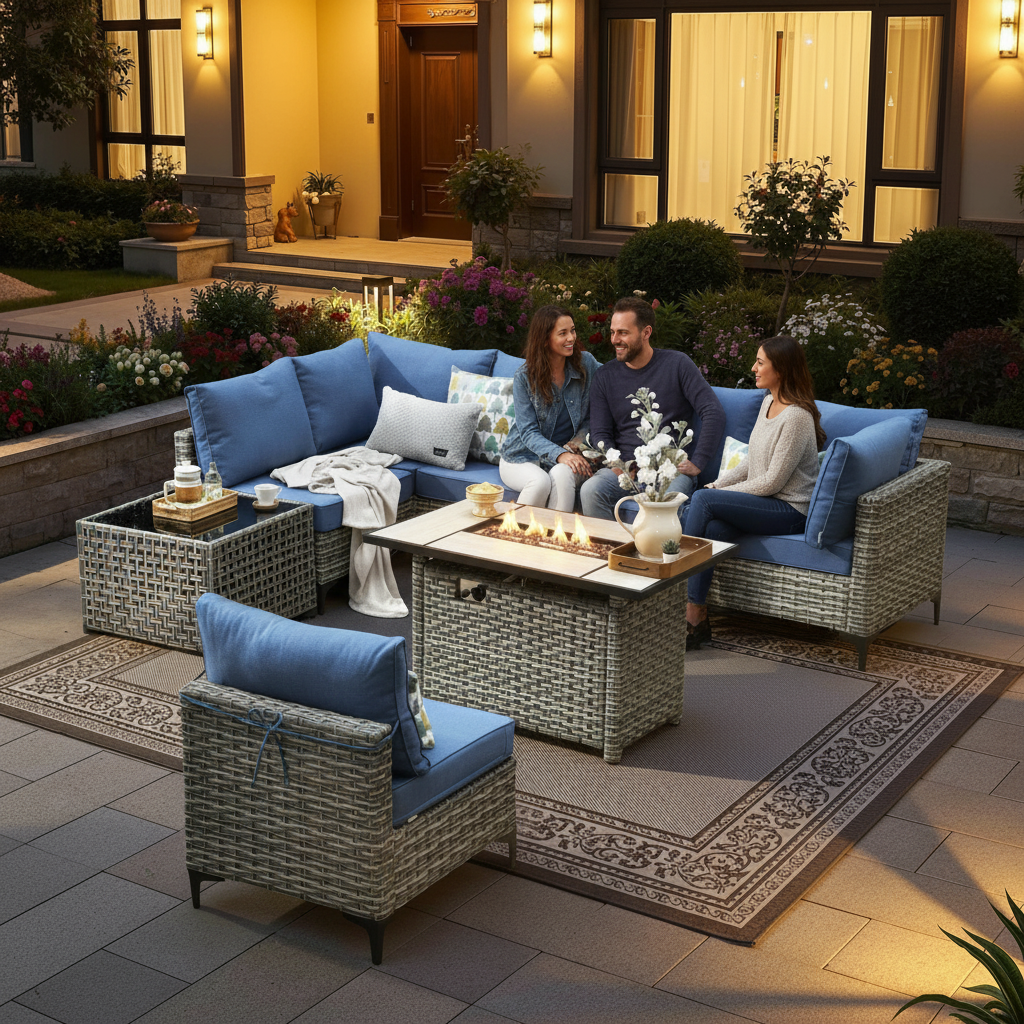
A fire pit table serves as the natural focal point for outdoor gatherings, but creating an effective conversation zone requires balancing safety clearances, comfortable seating distances, traffic flow, and the available patio footprint. By following practical layout principles, clearance guidelines, and modular configuration strategies, homeowners can design inviting fire pit conversation areas that support evening entertaining without compromising movement or compliance with local fire rules.
Proper planning prevents common regrets such as cramped seating that forces guests too close to heat, blocked walkways that disrupt flow, or configurations that ignore roof overhangs on covered patios. This guide translates safety standards and design heuristics into actionable steps tailored to small and medium patios, helping you select and arrange modular patio furniture for both intimacy and practicality.
Why Fire Pit Placement Changes Your Patio Layout Strategy
A fire pit table transforms a standard patio into a conversation pit by drawing people inward, which alters everything from seating angles to required buffers. Unlike a standalone coffee table, the fire feature introduces heat, flame height, and regulatory clearances that must take priority over pure aesthetics. This means your layout must start with the fire pit as the anchor and then work outward, ensuring no seating blocks emergency access or places combustible materials within prohibited zones.
Local fire codes often require portable outdoor fireplaces to remain a safe distance from structures, fences, and other combustibles, with many jurisdictions specifying at least 10 feet from anything that can burn. As this NFPA wildfire prevention guidance explains, fire pits should be used outdoors and kept at least 10 feet from anything that can burn, with additional local-code checks before setup. Some municipalities extend this to 15 feet from structures or even 15-25 feet in recreational fire rules, so always verify with your local fire department before finalizing furniture placement.
Accessibility considerations further influence design. Guidance for outdoor developed areas recommends 48 by 48 inches of clear ground space on usable sides of fire features, supporting the need for open buffers rather than crowding chairs directly against the pit. These rules reinforce that effective conversation pits prioritize navigability alongside intimacy.

How to Measure Your Patio and Establish Clearance Zones
Begin any fire pit patio furniture project by measuring the full usable area, including setbacks from walls, roof edges, railings, and high-traffic paths. Record the total square footage, then subtract mandatory clearance zones around the fire pit table itself. For most residential setups, maintain at least 10 feet from the fire pit to combustible surfaces such as wood overhangs, vinyl siding, or fabric awnings, though this distance can increase under local ordinances.
Next, map circulation space. Outdoor seating plans should preserve clear pathways of at least 3 feet wide so guests can move behind seated positions without stepping into the fire zone. On the fire pit itself, incorporate the 48-by-48-inch clear ground space heuristic on primary approach sides to keep the area navigable. Conversation distance typically works best between 4 and 8 feet from the pit edge to seating, allowing comfortable talking without excessive heat exposure.
Use painter's tape or temporary markers on the patio to test these dimensions before purchasing. This step reveals whether your footprint supports a full sectional, requires a more compact conversation set, or benefits from modular pieces that can be rearranged seasonally. Always cross-check against manufacturer instructions for your specific fire pit table, as many models list exact clearance and fuel-type requirements.
Choosing the Right Modular or Sectional Configuration for a Fire Pit
Modular patio furniture offers the flexibility needed around a fire feature because individual pieces can be reconfigured for different group sizes or seasonal needs. When selecting a conversation set with fire pit table and chairs, prioritize sets that allow both curved and linear arrangements while maintaining the required safety buffers.
Look for sectionals with swivel chairs or ottomans that can face inward without forcing tight spacing. Our OVIOS Modular Wicker Patio Furniture Set with Fire Pit Table & Coffee Table provides exactly this adaptability in an 8-piece configuration that works for 6-10 guests. Similarly, the OVIOS Wicker Patio Sectional Conversation Set with Fire Pit Table & Swivel Chairs combines 360-degree movement with a 42-inch fire pit, making it easier to adjust angles as group dynamics change.
For larger entertaining, consider 10-piece or greater modular systems from our 8-10 Seats collection. These sets allow zoning: one area focused on the fire pit for conversation and another for dining or lounge seating further away. Choose materials like all-weather wicker and Olefin fabrics that meet relevant furniture safety standards near heat sources, as highlighted in broader compliance resources.
Recommended Layouts for Different Patio Sizes and Shapes
Three primary configurations work well around fire pit tables: L-shape, U-shape, and wraparound. Each trades off conversation intimacy, circulation, and space efficiency differently depending on whether your patio is small (under 200 square feet) or medium (200-400 square feet).
An L-shape layout positions seating along two adjacent sides of the fire pit, leaving the other sides open for access. This works particularly well on narrow or corner patios because it preserves walkway space on at least two sides while keeping most seats within the ideal 4- to 8-foot conversation range. In small spaces, pair it with swivel rockers to allow guests to turn toward or away from the fire easily.
U-shape arrangements surround the fire pit on three sides, creating the strongest sense of enclosure and conversational focus. This layout shines on medium patios where the extra depth allows the required 3-foot circulation path behind the back row. It suits families who entertain regularly, but avoid it on very small decks because the enclosed form can reduce perceived openness and complicate movement.
Wraparound designs extend seating along multiple sides or even partially encircle the pit, ideal for larger or unusually shaped areas. They maximize seating capacity but demand the most square footage to maintain clearances and avoid crowding. On covered patios, ensure the entire arrangement stays well away from roof edges, as some fire rules specify 15-foot buffers from structures.
The radar chart below illustrates these tradeoffs using heuristic scores derived from standard patio ratios and the clearance thresholds discussed earlier. Higher scores indicate better relative fit within each criterion.
Modeled for Comparison - Adjust for Local Codes: Fire Pit Patio Layout Tradeoffs
Heuristic comparison of layout fit for small and medium patios using common clearance targets and circulation rules.
View chart data
| Series | Safety clearance fit | Conversation comfort | Circulation ease | Space efficiency | Layout flexibility |
|---|---|---|---|---|---|
| Small Patio - L-shape | 3.0 | 4.0 | 3.0 | 4.0 | 4.0 |
| Small Patio - U-shape | 2.0 | 4.0 | 2.0 | 3.0 | 3.0 |
| Small Patio - Wraparound | 2.0 | 3.0 | 2.0 | 2.0 | 2.0 |
| Medium Patio - L-shape | 4.0 | 4.0 | 4.0 | 4.0 | 4.0 |
| Medium Patio - U-shape | 4.0 | 5.0 | 4.0 | 3.0 | 4.0 |
| Medium Patio - Wraparound | 3.0 | 4.0 | 3.0 | 3.0 | 3.0 |
Modeled for comparison only. Scores are heuristic, derived from patio design ratios and the supplied thresholds: 10ft+ safety from combustibles, 48x48in clear fire-pit zone, 4-8ft ideal conversation distance, and 3ft minimum walkways. Use as a planning aid; local codes and site conditions may change the fit.

For detailed examples of arranging modular pieces for various group sizes, see our companion guide on how to arrange modular patio furniture for different gathering sizes. When pairing furniture with fire features, review how to perfectly size and pair a fire pit table with your outdoor sectional for height-matching and shape recommendations.
Common Mistakes to Avoid When Designing a Fire Pit Conversation Area
Many homeowners unintentionally create unsafe or uncomfortable layouts by pushing seating too close for dramatic effect or ignoring traffic patterns. Placing chairs within 3 feet of the fire pit edge often leads to heat discomfort and violates typical clearance heuristics. Another frequent error is positioning the entire arrangement under a roof overhang or too near walls without confirming the 10- to 15-foot structural buffer required in many jurisdictions.
Blocked walkways represent a major friction point. Ottomans, corner pieces, or extended sectional arms can narrow paths below the 3-foot circulation minimum, forcing guests to step over furniture or brush past the fire. In small patios, this quickly turns an inviting space into a crowded one. Over-reliance on symmetrical arrangements without testing actual movement also creates awkward angles that prevent easy conversation or exit.
To avoid these issues, adopt a modular mindset from the start. Our OVIOS Outdoor Patio Conversation Set with Fire Pit Table allows quick reconfiguration if initial placement feels off. Always leave the fire pit accessible from multiple sides and test the layout with all intended users present. For broader outdoor room planning, consult the 2026 Guide to Modular Outdoor Living.
Fire Pit Patio Layout Planning Checklist
Use this checklist before purchasing or arranging your conversation set with fire pit table and chairs:
- Measure the full patio and mark mandatory 10-foot (or local code) clearance from combustibles, walls, and roof edges.
- Verify at least 48 by 48 inches of clear space on primary sides of the fire pit and 3-foot-wide circulation paths behind seating.
- Confirm conversation distances fall between 4 and 8 feet from pit edge to seating for most guests.
- Choose modular or sectional pieces that can be reconfigured rather than fixed sofas for future flexibility.
- Test the full layout with tape markers and actual furniture sizes before permanent placement.
- Check manufacturer instructions and local fire department rules for your specific fire pit model and fuel type.
- Select weather-resistant materials that comply with applicable furniture safety standards near heat sources.
- Ensure the chosen configuration matches your typical group size without forcing overcrowding.
Following these steps helps translate abstract safety and design principles into a functional, inviting outdoor conversation pit that supports years of comfortable use. For additional options, explore our full range of outdoor furniture with fire pit sets or patio sectional collections.
Frequently Asked Questions
How Far Should Patio Chairs Be From a Fire Pit Table?
Ideal conversation distance usually falls between 4 and 8 feet from the fire pit edge to the front of seating, allowing comfortable talking while limiting direct heat exposure. This range must be balanced against the stricter 10-foot or greater clearance to combustibles required by many fire safety guidelines. Always measure your specific setup and confirm with local codes, as requirements can range from 10 to 25 feet depending on jurisdiction.
What Is the Minimum Clearance Needed Around a Fire Pit on a Patio?
Most authorities recommend at least 10 feet from the fire pit to any combustible material, including walls, roofs, fences, or furniture components that are not explicitly rated for close proximity. In addition, maintain 48 by 48 inches of clear ground space on usable sides and 3 feet of unobstructed walkway behind seated positions. These are planning starting points; local fire departments may impose larger buffers, particularly under covered areas.
Is an L-Shape or U-Shape Better for a Fire Pit Conversation Set?
An L-shape generally performs better on smaller patios because it preserves more open circulation space and adapts easily to corner placements. A U-shape creates stronger conversational intimacy and works well on medium or larger patios where depth allows proper rear walkways. The best choice depends on your exact square footage, typical group size, and whether you prioritize openness or enclosure. Modular sets let you test both configurations without commitment.
Can You Place a Fire Pit Table Under a Covered Patio?
Covered or semi-covered patios require extra caution because roof overhangs and walls count as combustible surfaces under many fire codes. Some municipalities mandate 15 feet or more from structures. If your patio has any overhead cover, position the fire pit and all seating to maintain the full required clearance, ensure excellent ventilation, and confirm compliance with both the fire pit manufacturer and local fire marshal before use.
How Many People Can Sit Comfortably Around a Standard Fire Pit Table?
A typical 42-inch fire pit table comfortably seats 4 to 6 people when using modular sectional pieces or swivel chairs spaced at proper conversation distance. Larger 50,000 BTU models or rectangular designs paired with 8- to 10-piece sectionals can accommodate 8 to 12 guests, provided the patio footprint supports the necessary circulation and clearance zones. Prioritize flexible modular furniture so you can expand or contract the arrangement as needed.
What Should You Check Before Buying Modular Patio Furniture for a Fire Pit Area?
Verify that the set allows reconfiguration while maintaining required safety buffers, that materials meet relevant heat and weather resistance standards, and that the fire pit component includes proper manufacturer clearance instructions. Test the height match between table and seating, confirm swivel or rocking options suit your group, and ensure the overall dimensions fit your measured patio after subtracting clearance zones. Reviewing local fire pit guidelines early prevents costly mismatches.

Leave a comment
This site is protected by hCaptcha and the hCaptcha Privacy Policy and Terms of Service apply.