



Why Safety and Circulation Must Come Before Style
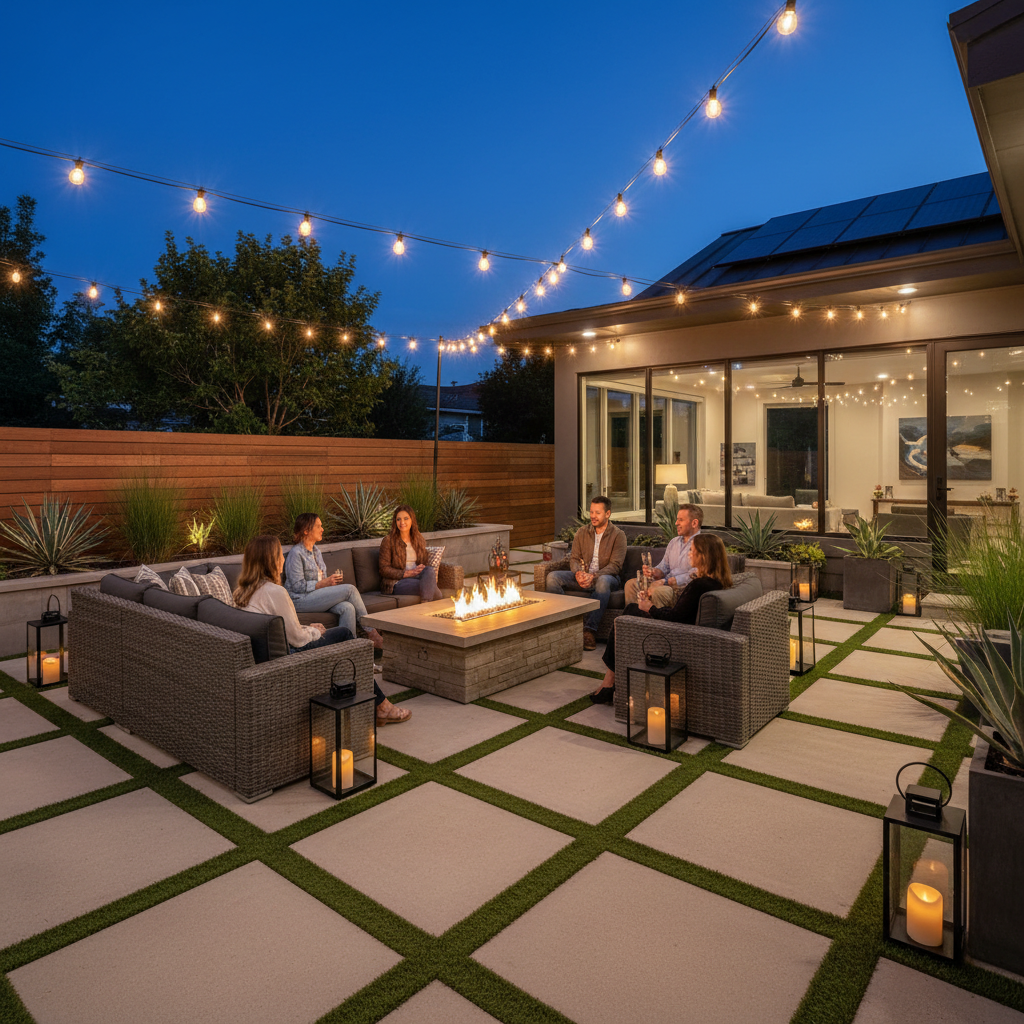
Integrating a fire pit into your outdoor living room creates a natural gathering spot, but a successful layout requires balancing cozy proximity with essential safety clearances. Many homeowners imagine a tight circular seating arrangement, yet fire safety experts and organizations like the National Fire Protection Association (NFPA) generally recommend keeping recreational fires at least 10 feet away from structures and combustible materials.
While modern propane fire tables often have specific manufacturer-tested clearances that may allow for closer seating, the 10-foot rule remains a vital benchmark for open wood-burning pits. Beyond fire safety, accessible design standards suggest maintaining at least a 36-inch clear width for main walkways. When these two requirements are ignored, the result is often a "pinch point" where guests feel trapped or uncomfortably hot. Prioritizing these thresholds prevents the common regret of having to move heavy modular pieces after your first gathering.
This spatial planning resource offers additional benchmarks for aligning modular patio furniture with safe outdoor living principles.
Key Safety Thresholds for Fire Pit Sectional Layouts
Successful arrangements treat the fire pit as a dynamic heat source rather than a static coffee table. The following thresholds serve as a starting point for planning your layout. Always prioritize the specific clearance requirements listed in your fire pit’s owner’s manual.
- Combustible Clearance (The 10-Foot Rule): For wood-burning fire pits, a 10-foot radius from structures and combustibles is the standard safety buffer. For gas fire tables, seating is typically placed closer (often 3–5 feet), but decorative items like throws or umbrellas should still respect a wider margin.
- The 36-Inch Circulation Path: To ensure guests can move safely—especially in the dark—maintain a 36-inch clear walkway around the exterior of the seating group. This prevents "squeezing" past the fire to reach a seat.
- Heat Output (BTU) Considerations: A typical 42-inch propane fire pit table with a 40,000–55,000 BTU output generates significant radiant heat. If your sectional is too close, the heat can become overwhelming for guests and may eventually degrade fabric fibers.
- Sectional Footprint: An 8- to 15-piece modular set can span 12–18 feet. Ensure your patio dimensions can accommodate both the sectional's length and the necessary safety buffers on all sides.
If your patio cannot accommodate both the recommended safety zone and 36-inch pathways, it is safer to scale back to a smaller modular configuration or choose a more compact fire feature.
Safe Modular Sectional Layout Around a Fire Pit
Top-down planning diagram showing safe vs unsafe zones, circulation ring, and patio-shape fit boundaries.
View chart data
| X | Fire Pit | Circulation Min | Combustible Boundary | Square Patio | Rectangular Patio | L-Shape Patio | Sectional Footprint (typical) |
|---|---|---|---|---|---|---|---|
| R=21 in | 21 | 18 | 120 | 100 | 120 | 92 | 90 |
| R=36 in | 0 | 0 | 0 | 100 | 90 | 118 | 54 |
| R=120 in | |||||||
| Square | |||||||
| Rectangular | |||||||
| L-shape | |||||||
| Sectional |
Built from NFPA-style 10 ft combustible clearance guidance, a 36 in circulation minimum from access/egress planning practice, a typical 42 in fire pit diameter, and bounded internal modeling to show when patio shapes flip from safe to unsafe. Distances are illustrative planning geometry, not a measured site survey.
This planning diagram illustrates how safety boundaries and circulation rings interact with common patio shapes. Square or generously proportioned rectangular patios more easily satisfy these rules, while narrow spaces often require an offset fire pit to remain functional.
Layout Scenarios: Adapting to Your Patio Shape
The ideal modular sectional layout depends heavily on your patio’s footprint. A full surround works beautifully on a large open deck but can violate circulation rules in tighter spaces.
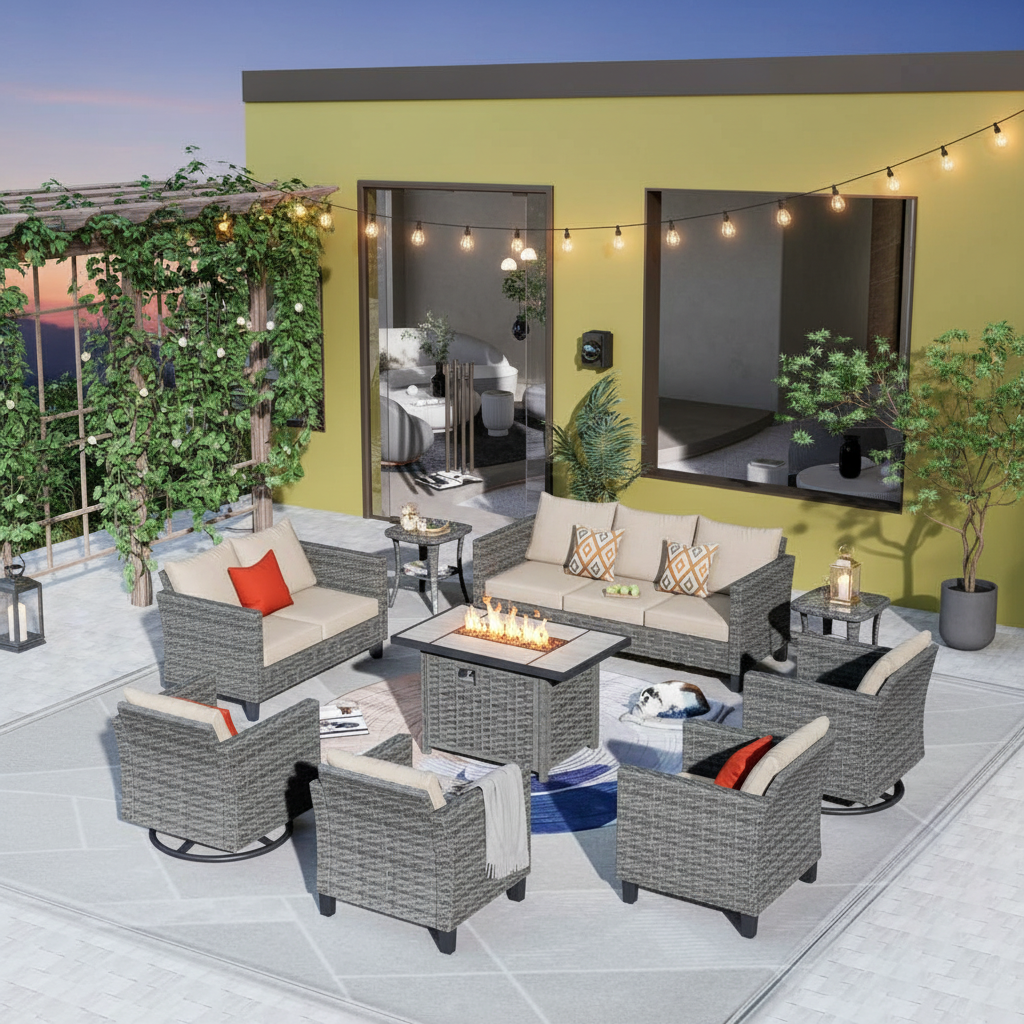
Rectangular Patios: This is the most common suburban setup. Instead of centering the fire pit, try placing it slightly off-center toward one long side. Arrange the modular sectional in a wide U-shape or two facing sofas. This preserves the 36-inch circulation path along the perimeter while keeping the seating oriented toward the warmth.
Square or Expansive Patios: A gentle crescent or balanced "L" layout is ideal here. Use modular pieces to create a conversation-focused arc. We recommend leaving at least one side of the fire pit open to allow for easy serving and to provide a clear exit route that doesn't require walking behind other guests.
L-Shaped Patios: Treat the corner as an anchor. Position the fire pit in the wider "arm" of the L and run the sectional along the two walls. This "open-angle" approach avoids forcing guests to walk between the seating and the fire feature, which is a common trip hazard.
Covered or Partially Covered Spaces: Heat and smoke can become trapped under roofs or pergolas. In these environments, favor an open-sided arrangement and ensure the fire pit is rated for use under a ceiling. Increasing the distance between the fire and the sofa cushions is also recommended to prevent heat buildup in enclosed areas.
Material and Furniture Choices for Fire-Adjacent Seating
When seating is placed near a heat source, material durability is paramount. Look for high-quality materials that can withstand temperature fluctuations and UV exposure:
- Frames: Heavy-duty PE wicker over powder-coated aluminum frames provides stability. Avoid ultra-lightweight furniture that could be shifted or blown toward the fire pit by high winds.
- Fabrics: Solution-dyed Olefin or acrylic fabrics are preferred for their resistance to fading and their ability to handle the occasional stray ember better than standard polyester.
- Maintenance: Choose sets with removable, washable cushion covers. Soot or ash from wood-burning pits can be abrasive; being able to deep-clean the covers ensures the longevity of your set.
When selecting a large 12- to 15-piece set, remember that the modular nature is your biggest advantage. You don't have to use every piece in one continuous line; breaking the set into a primary "fire zone" and a secondary "relaxation zone" often creates a better flow.
Practical Checklist: Arranging Your Sectional
Use this step-by-step process before finalizing your furniture placement:
- Mark the "Hot Zone": Use painter's tape to mark the footprint of your fire pit and the manufacturer’s recommended clearance zone.
- Map the Flow: Identify the primary entrance to the patio (e.g., the sliding glass door). Ensure there is a 36-inch unobstructed path from that door to the seating.
- Position the Fire Pit First: The fire feature is the "anchor." Once it is safely placed, build the sectional outward from it.
- Check the Wind: If your area has a prevailing wind, position the main seating "upwind" or perpendicular to the wind to keep smoke (in wood-burning pits) out of guests' faces.
- The "Night Test": Once arranged, test the layout. Sit in every seat to check for "hot spots" and walk the paths to ensure no one will trip over a rug or a sectional leg in low light.

When to Adjust Your Strategy
Not every patio is suited for a large sectional and a central fire pit. Avoid forcing this arrangement if:
- The patio is smaller than 15' x 15' (which often leads to cramped, unsafe clearances).
- The fire pit would sit directly in the only path to a staircase or emergency exit.
- The space is primarily used by unsupervised pets or very young children.
In these cases, consider a "side-car" arrangement where the fire pit is placed at the edge of the patio with a few club chairs, leaving the modular sectional in a separate, fire-free zone for lounging.

Final Thoughts
A well-planned modular sectional arranged around a fire pit transforms a backyard into a functional outdoor room. By respecting the 36-inch circulation rule and following manufacturer safety clearances, you create a space that is as safe as it is inviting.
Note: This guide provides general layout and comfort recommendations. Always consult your local fire codes and the specific safety manual for your fire feature. If you are installing a permanent gas line or a large masonry fire pit, consult with a licensed professional to ensure all local setbacks and safety standards are met.
Ready to design your space? Explore our collection of modular sets designed for versatility, or see our guide on how to size and pair a fire pit table with your outdoor sectional for more expert tips.

Leave a comment
This site is protected by hCaptcha and the hCaptcha Privacy Policy and Terms of Service apply.