



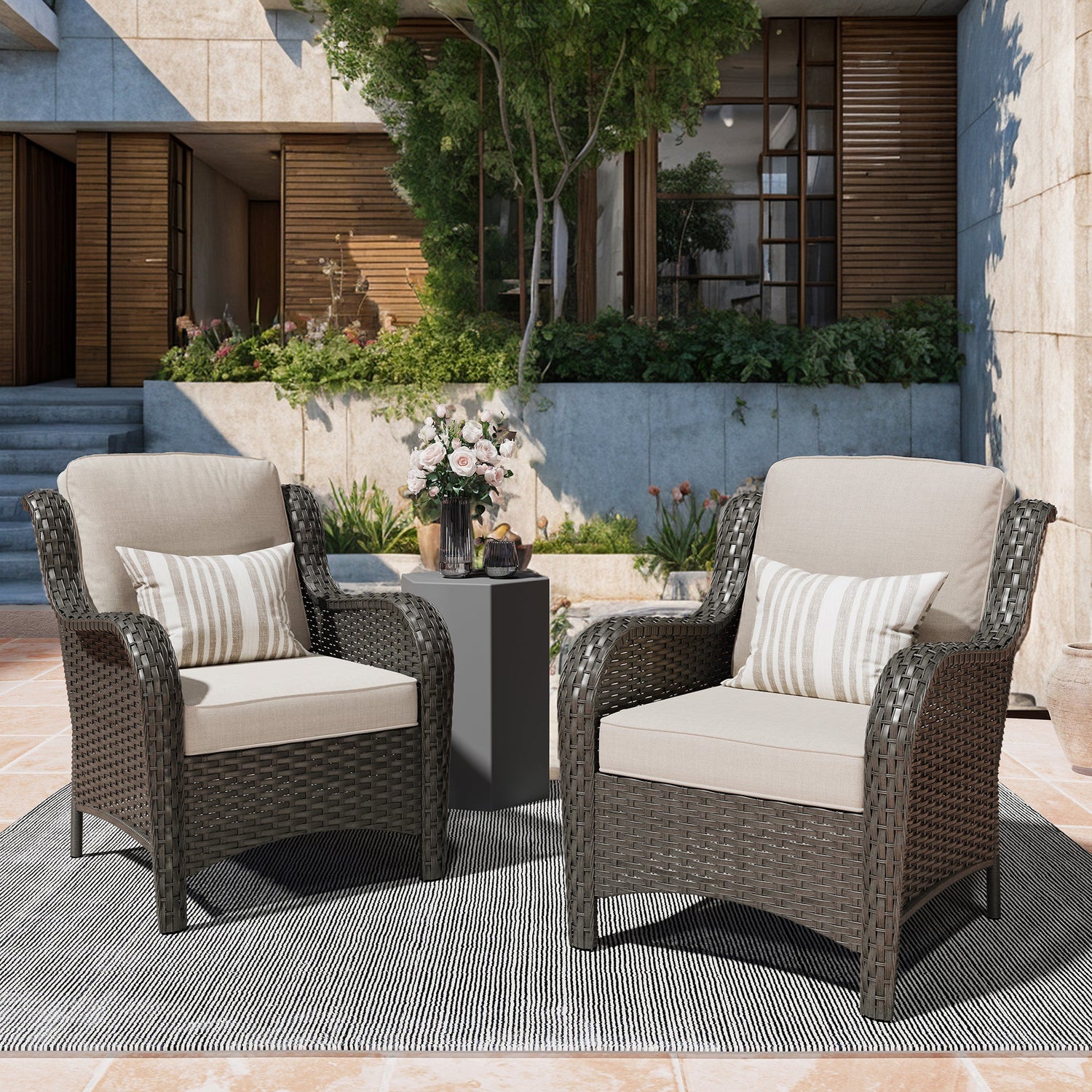
High-back ergonomic patio chairs can make extended outdoor lounging far more comfortable than low-back or shallow designs by providing sustained upper-back and lumbar support, especially when paired with deep seating and wide armrests. For many homeowners who spend hours reading, chatting, or relaxing on the patio, these features help maintain a neutral posture instead of forcing slouching or fatigue that often appears after 20–30 minutes in standard chairs.

The difference becomes obvious once you sit back fully. A properly designed high-back chair supports the spine in a slightly reclined position, reduces pressure on the lower back, and lets your arms rest naturally. This setup aligns with core ergonomic principles that emphasize full-body support rather than style alone.
What Makes a Patio Chair Truly Ergonomic
Ergonomic seating guidance emphasizes that a good chair should support the back, legs, buttocks, and arms while reducing awkward postures. In an outdoor context, this means the chair must work with how people actually use their patio—leaning back to talk, reading for an hour, or lingering over coffee without constantly shifting to relieve pressure.
Official sources highlight several non-negotiable elements. The backrest should be high enough to support the back in a variety of seated postures, preserving the natural curve of the lower back rather than letting it flatten. Seat depth should support the thighs while leaving clearance behind the knees, and the seat should be wide enough to allow natural positioning without feeling cramped. Armrests should let the forearms rest comfortably at the sides.
These principles explain why many shoppers regret choosing decorative patio furniture that looks inviting in photos but fails during real use. This GSA ergonomic seating adjustment guide outlines the foundational support requirements that translate directly to outdoor furniture decisions.

Why High-Back Designs Deliver Superior Long-Term Comfort
A backrest that is high enough to support the back in a range of seated postures is preferable to a low backrest for relaxed, leaned-back sitting. High-back patio chairs extend support up toward the shoulders and neck, which becomes valuable during longer sessions when the upper back starts to tire.
Low-back chairs often stop below the shoulder blades. This leaves the upper torso unsupported, encouraging forward slouching that strains the neck and lower back over time. In contrast, a high-back design lets you shift between upright conversation and relaxed reclining while the chair continues to cradle the spine.
Good seated posture should support the low back and preserve its natural curve. When a chair provides this, users report less fatigue even after extended periods outdoors. The CSA Group chair setup guidance reinforces that adequate backrest height is key for varied postures, a principle that applies equally to patio lounging and office seating.
For taller users, the proportional fit matters even more. Taller users may find high-back, deeper chairs a better proportional fit because the backrest reaches higher on the torso and the seat depth better accommodates longer thighs.
The Role of Deep Seating and Wide Armrests
Seat depth should support the thighs for comfortable sitting over time. Shallow seats force users to perch on the edge or slide forward, cutting off thigh support and increasing pressure behind the knees. Deep seating—typically 20–24 inches or more—lets the full thigh rest while still allowing the lower back to contact the lumbar area.
Seat depth should support the thighs while leaving room behind the knees for comfort. When this balance is achieved, the chair feels stable rather than restrictive, which is especially important for older adults or anyone who wants to stay seated without constant readjustment.
Extra-wide armrests further enhance the experience. When armrests are broad enough (many premium models offer 7–8 inches), users can rest their forearms and elbows comfortably without hunching the shoulders. This reduces upper-body tension and supports a more open, relaxed posture during conversation or reading.
Ergonomic guidance commonly recommends keeping the forearms comfortable at the sides. Wide armrests make this possible outdoors, where people often use chairs differently than at a dining table. A seat that is wide enough to let you sit back naturally is more comfortable than one that feels cramped, particularly in social settings where guests shift positions frequently.
Many OVIOs conversation sets feature 7.68-inch extra-wide armrests precisely for this reason. Check the OVIOS Outdoor Conversation Set with 7.68" Extra-Wide Armrests and Rocking Chairs to see how these dimensions translate into real-world comfort.
High-Back vs Low-Back Patio Furniture: The Ergonomic Difference
Many shoppers assume any outdoor chair will feel fine for short periods. In practice, many report that low-back or shallow outdoor chairs become uncomfortable during longer sitting sessions. The tipping point often arrives between 20 and 30 minutes when the lower back loses support and posture collapses.
High-back designs address this by maintaining contact across more of the spine. They encourage a neutral or slightly reclined posture instead of forcing strain. This is why the high-back versus low-back ergonomic difference consistently favors high-back chairs for anyone prioritizing comfort over minimalism.
That said, high-back chairs are not automatically superior in every situation. The choice depends on your primary use case.
Scenario Matrix: When High-Back Chairs Win (and When They Don’t)
The real decision framework compares how long you plan to sit, how stationary you will be, and whether you value sustained support over easy entry/exit or a lower visual profile.
High-back ergonomic chairs tend to excel in relaxed, longer-duration scenarios because they support posture variety and reduce fatigue. They lose appeal when the main activity involves frequent movement, very casual perching, or tight spaces where bulk matters more than back support.
Here is a modeled comparison that visualizes these trade-offs using heuristic scores derived from ergonomic principles and common usage patterns. Scores reflect relative comfort and support across typical outdoor scenes (higher is better).
Modeled Comfort Comparison for Decision Guidance: High-Back vs Low-Back vs Adirondack
Heuristic scenario-based comfort/support comparison for decision guidance
View chart data
| Series | Backyard Lounging | Poolside Casual | Deck Conversation | Reading Session | Family Gathering | Small Space Use |
|---|---|---|---|---|---|---|
| High-Back Ergonomic | 9.0 | 4.0 | 7.0 | 9.0 | 7.0 | 4.0 |
| Low-Back Standard | 5.0 | 8.0 | 6.0 | 4.0 | 6.0 | 8.0 |
| Adirondack | 8.0 | 7.0 | 8.0 | 7.0 | 7.0 | 5.0 |
Illustrative ergonomic model based on official guidance on lumbar support, neutral posture, seat depth, and armrest support (GSA, CDC, CSA, Pitt, Virginia EHS, Harvard, UCLA, Brown) plus scenario logic from the provided matrix. Scores are heuristic 1-10 for planning, not measured performance.
This radar chart illustrates how high-back ergonomic chairs tend to dominate longer, more stationary uses while low-back and Adirondack styles can feel more appropriate for brief or highly social settings. Use it as a quick self-check: if most of your patio time falls into the high-scoring zones for high-back chairs, that design will likely deliver the comfort you are seeking.
Common Myths About Outdoor Ergonomic Seating
Several misconceptions persist in online discussions and product marketing.
Myth: A high-back patio chair is automatically more ergonomic than a low-back chair. Reality: Back height helps only when combined with proper lumbar support, seat depth, width, and usable armrests. A tall back on a shallow or narrow seat can still leave the lower spine unsupported and create new pressure points. The CDC guidance on optimizing work environments stresses preserving the low-back curve, which requires more than height alone.
Myth: If a chair feels good in the first few minutes, it will stay comfortable. Reality: Many shoppers report that low-back or shallow outdoor chairs become uncomfortable during longer sitting sessions. First impressions often ignore how posture degrades without sustained support.
Myth: Armrests and deep seats are optional luxuries for patio furniture. Reality: These elements directly affect forearm comfort and thigh support. Without them, even a high back may not prevent fatigue. The Virginia EHS workstation self-check notes that the lower back should be supported when you sit all the way back—an outcome that depends on the full geometry of the chair.
Buyer Checklist: How to Choose Ergonomic Patio Chairs That Actually Deliver
Before purchasing, run through these practical checkpoints. They translate abstract ergonomic guidance into concrete actions you can perform in a showroom or while reviewing product dimensions.
-
Sit all the way back. Does the lower back make solid contact with the chair while your shoulders remain supported? If you have to perch forward to feel lumbar support, the design is likely too shallow.
-
Check thigh support. With your back against the chair, do your thighs rest fully on the seat without pressure behind the knees? Aim for at least 20 inches of effective depth for most adults.
-
Test armrest height and width. Can you rest your forearms comfortably without shrugging your shoulders? Extra-wide armrests (7 inches or more) usually provide better relaxation than narrow ones.
-
Evaluate for your height. If you are over 6 feet, confirm the backrest reaches at least to your shoulder blades and the seat depth accommodates longer legs. Taller users may find high-back, deeper chairs a better proportional fit.
-
Consider movement. Will you use the chair mainly for lounging and reading, or for frequent getting up and down during gatherings? Swivel and rocking functions can add convenience in conversational settings.
-
Inspect materials for longevity. Look for weather-resistant wicker, rustproof frames, and removable, spill-resistant cushions that maintain their support over seasons. Durable construction prevents the ergonomic benefits from disappearing as the chair ages.
Our OVIOS 4-Piece Outdoor Patio Set with Swivel Chairs combines high-back support, rocking swivel motion, and thick cushions that address many of these points simultaneously. Similarly, the OVIOS VNC Series Patio Swivel Chair 3-Piece Set offers a compact high-back option for smaller patios.
For broader inspiration, explore our Swivel Chairs collection or Patio Conversation Sets.
Additional reading that expands on these ideas includes Why Ergonomic High-Back Seating is Essential for Outdoor Living Rooms and Why High-Back Patio Chairs Are the Secret to Outdoor Comfort. You may also find value in our comparison of Conversational Sets vs. Sectionals.
Final Decision Guidance
High-back ergonomic patio chairs offer clear advantages for anyone who values all-day comfort over minimal visual footprint. They tend to pay off most when your outdoor routine includes longer lounging, reading, or relaxed conversation rather than quick meals and constant movement.
The best choice still depends on your specific space, body size, and how you actually use the patio. Measure your typical sitting duration, test chairs in person when possible, and prioritize the combination of high back, deep seat, and wide armrests rather than any single feature. When these elements align, the chair stops being just furniture and becomes a place you genuinely want to spend time.
Comfort in outdoor living ultimately comes down to support that matches real human posture over real amounts of time. High-back designs, when thoughtfully executed, deliver exactly that.
Comfort and Ergonomics Disclaimer
This article discusses setup and comfort considerations for patio furniture based on general ergonomic principles. It does not constitute medical advice, diagnosis, or treatment. Chair comfort is highly individual and depends on personal physiology, existing conditions, and specific use. If you experience persistent discomfort, back pain, or have pre-existing eye, neck, or musculoskeletal conditions, consult a qualified healthcare professional. Always test furniture in your own environment before making large purchases.

Leave a comment
This site is protected by hCaptcha and the hCaptcha Privacy Policy and Terms of Service apply.