



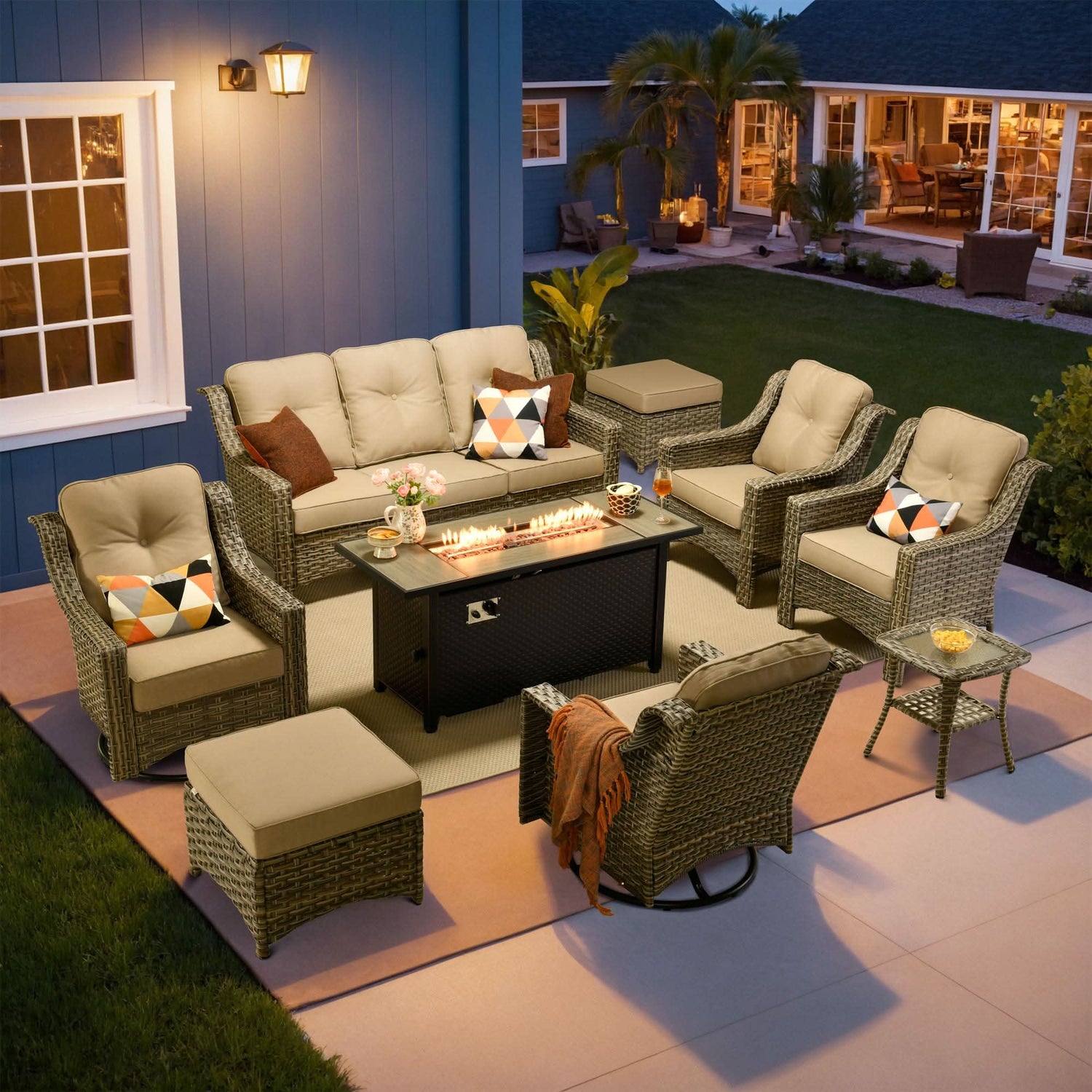
Choosing outdoor furniture that lasts beyond a single season requires more than selecting weather-resistant materials. A true lifecycle approach weighs upfront cost against repairability, replacement part availability, cushion longevity, fire pit safety clearances, and end-of-life recyclability. For new homeowners, landscape designers, and property managers, this framework helps avoid repeated full replacements and ensures safe integration in outdoor living spaces.

Executive Summary
The shift from fast furniture to lifecycle-oriented modular patio furniture can significantly alter five-year total cost of ownership. Modular systems with available replacement cushions and parts reduce the risk of total loss when individual components fail. However, fire pit integration demands strict attention to local clearance rules that vary by jurisdiction, often requiring substantial separation from combustible materials. Olefin and acrylic fabrics offer different durability profiles in cushion ecosystems, while PE wicker and aluminum frames present recycling challenges at end of life that depend on local infrastructure. This whitepaper provides decision tools, modeled comparisons, safety guidance, and practical checklists drawn from official fire safety sources and industry lifecycle considerations.
Readers should evaluate purchases based on expected usage horizon, proximity to heat sources, and willingness to maintain or replace components rather than entire sets. Local codes ultimately govern fire pit safety, and recyclability claims require verification against municipal programs.
Methodology: Assessing Fast Furniture vs Lifecycle Furniture
Fast furniture typically features lower initial prices but limited repair options, leading to full replacement when cushions fade, frames rust, or weaves degrade. Lifecycle furniture emphasizes modularity, standardized replacement parts, and durable materials designed for component-level servicing.
Assessment criteria include:
- Initial purchase price
- Expected component lifespan under typical outdoor exposure
- Availability and cost of replacement cushions and parts
- Repairability of frames and modular connections
- Compatibility with fire pit safety requirements
- End-of-life material recovery potential
This comparison relies on aggregated retail observations, manufacturer-reported specifications, and official guidance from fire authorities. Exact outcomes vary by climate, usage intensity, storage practices, and specific product construction. Evidence from state and county fire safety resources highlights that combustible patio furniture must often be kept clear of fire-adjacent zones.
This CAL FIRE home-hardening guidance recommends keeping combustible items, including patio furniture, out of the immediate 0–5 feet around combustible decks or similar surfaces. Similar Fairfax County recreational fire guidelines and other local authorities emphasize jurisdiction-specific separation from structures and combustibles.
The Modular Advantage: Expansion and Repairability Metrics
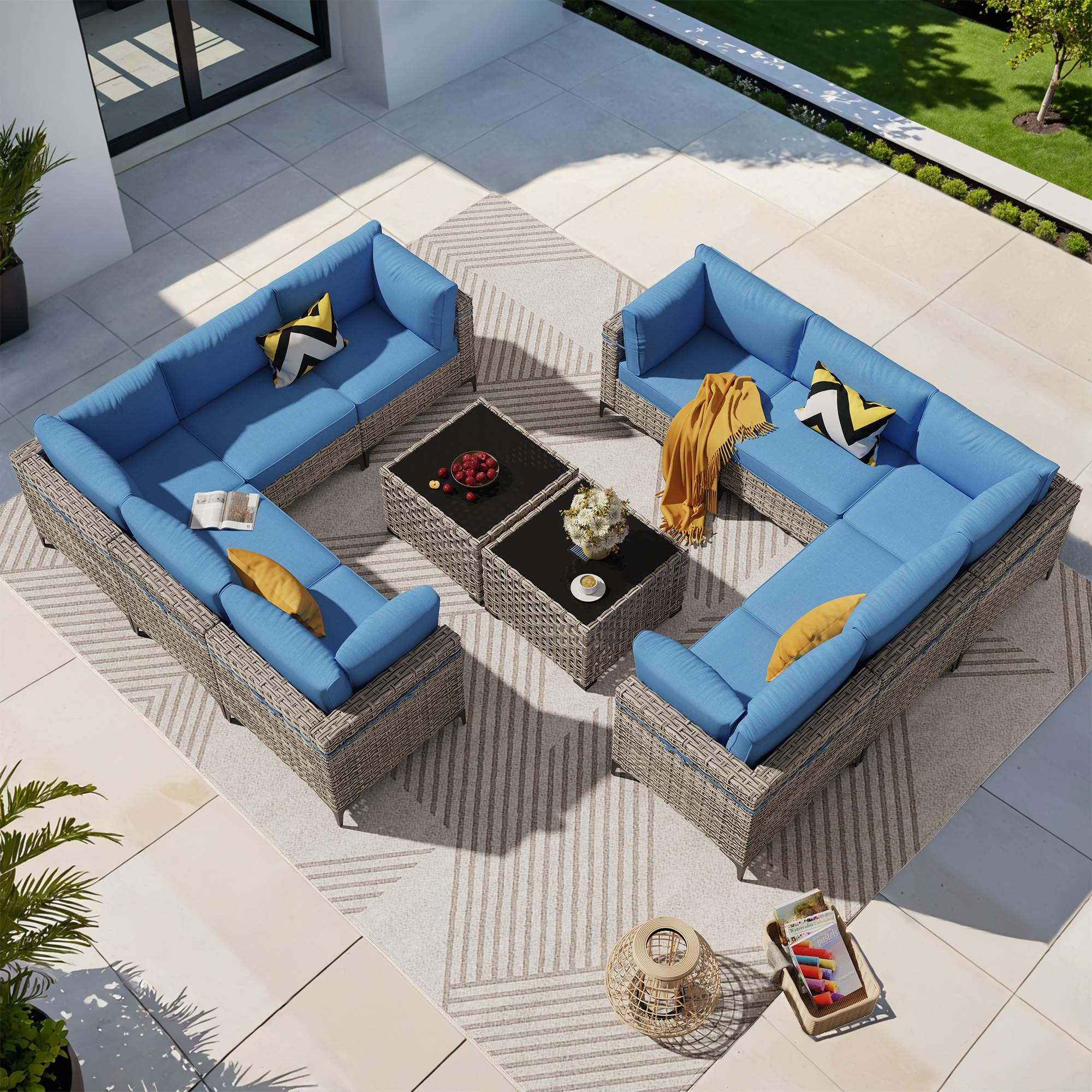
Modular patio furniture allows owners to replace individual sections, cushions, or connectors rather than discarding entire conversation sets. This design reduces waste and lowers long-term costs when damage occurs from storms, UV exposure, or heavy use.
Key repairability indicators include availability of matching replacement cushions, spare frame components, and standardized fasteners. Systems that support expansion let users add seating or tables without purchasing a completely new set.
In practice, modular construction prevents total loss scenarios common with non-repairable sets. When a single chair or cushion fails in a fixed set, the entire grouping may become visually inconsistent or unusable. Modular designs mitigate this by enabling targeted repairs.
Do not buy fast furniture if a single failed cushion, sling, or connector would force replacement of the whole set. This exclusion rule applies especially to property managers and designers handling multiple units or high-traffic areas.
The Cushion Ecosystem: Standardization, Replacement Costs, and Material Lifespans (Olefin vs. Acrylic)
Cushion replacement represents one of the largest ongoing costs in outdoor furniture ownership. Standardized sizes and available replacement options dramatically improve five-year value by extending usability without full set repurchase.
Olefin fabric generally offers strong resistance to water, stains, and fading with moderate UV durability. Acrylic fabrics often provide superior color retention and softness but may require more careful cleaning and can be more susceptible to certain stains. Actual lifespan depends on sun exposure, cleaning frequency, and storage during off-seasons.
Replacement cushion availability turns a potential liability into a manageable maintenance item. Sets with dedicated replacement programs allow owners to refresh appearance and comfort for a fraction of the original cost.
For detailed guidance on selecting and maintaining cushions, see this comprehensive cushion upgrade guide.
Fire Pit Integration: Safety Clearances and Material Heat Resistance
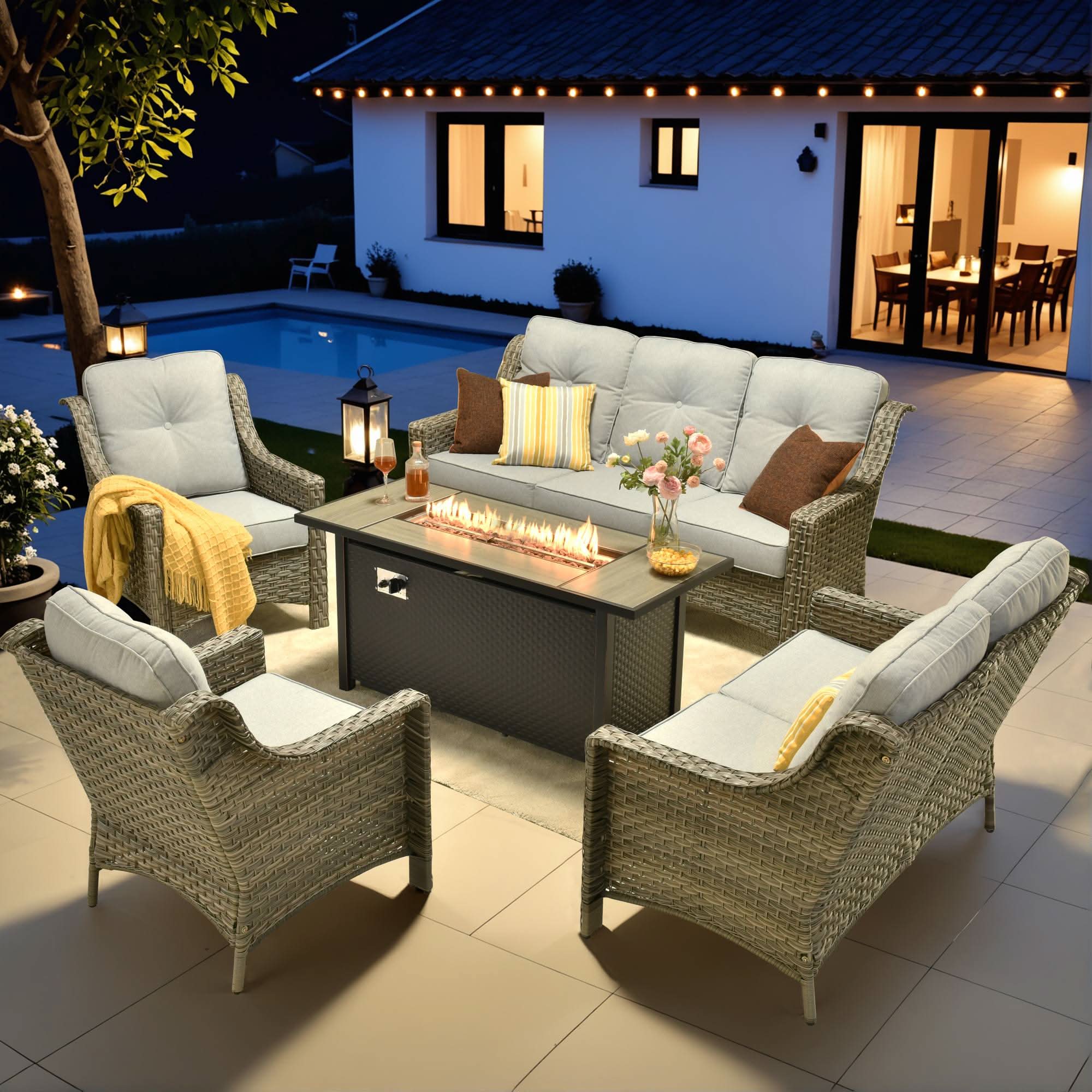
Integrating fire pits with synthetic wicker and cushioned seating requires careful layout planning. Synthetic materials and fabrics are combustible and must respect local fire codes that often mandate significant separation distances.
Some jurisdictions specify minimum clearances of 25 feet from structures and combustibles for recreational fires. Other guidance focuses on keeping flammable items outside the immediate fire-adjacent zone, particularly near combustible decks.
Spokane County fire marshal alerts and similar official notices illustrate how local rules can impose substantial buffers. Property owners should consult municipal fire departments before finalizing layouts that combine seating and heat sources.
Material heat resistance varies. Aluminum frames generally tolerate proximity better than synthetic weaves, but no outdoor furniture is designed as fireproof. Maintain recommended clearances and never place cushions or wicker directly adjacent to active fire pits.
Additional lawn protection considerations for fire pits are covered in this dedicated guide to preventing fire pit damage.
Sustainability Truths: Recyclability of PE Wicker and Aluminum
PE wicker (polyethylene) and aluminum are frequently marketed as sustainable choices, yet real-world recyclability depends on local processing capabilities and product construction.
Pure aluminum frames are highly recyclable where collection programs exist. Mixed-material PE wicker pieces often face contamination issues that reduce recovery rates. Many municipalities do not accept composite outdoor furniture in standard recycling streams.
True end-of-life sustainability requires design for disassembly, material labeling, and access to specialized recyclers. Claims of universal recyclability should be verified against specific local programs rather than accepted at face value.
Data Snapshots: 5-Year Cost of Ownership Comparison
The following chart illustrates a modeled comparison of cumulative costs between a typical fast furniture set and a modular lifecycle set over five years. The fast set assumes lower initial cost but requires full replacement approximately every two to three years due to component failure. The modular set carries a higher initial investment but benefits from targeted cushion replacement rather than total loss.
5-Year Total Cost of Ownership: Fast vs Modular Outdoor Furniture
Shows 5-year cumulative cost trajectories and the point at which the modular option avoids repeated replacement expense.
View chart data
| Category | Fast / Disposable Set | Modular / Lifecycle Set |
|---|---|---|
| Year 0 | 800.0 | 1700.0 |
| Year 1 | 800.0 | 1700.0 |
| Year 2 | 1600.0 | 1700.0 |
| Year 3 | 1600.0 | 1900.0 |
| Year 4 | 2400.0 | 1900.0 |
| Year 5 | 2400.0 | 1900.0 |
Illustrative modeled comparison based on the article brief: fast set assumes $800 upfront and full replacement every 2–3 years; modular set assumes $1,500 upfront plus $200 cushion replacement every 3 years. Values are not official statistics; they show relative 5-year cost trajectories and the crossover point when modular becomes lower cost.
This illustrative model demonstrates how repeated replacements can make lower-cost options more expensive over time. Actual costs depend on specific product pricing, local climate, and maintenance habits. Replacement cushion availability is a major variable that can improve modular economics further.
Table 1: 5-Year Total Cost of Ownership (Illustrative Comparison)
| Scenario | Initial Cost | Cushion/Part Replacements | Full Replacements | 5-Year Total (Modeled) | Source(s) |
|---|---|---|---|---|---|
| Fast/Disposable | $800 | Minimal | 2 | $2,400 | Retail aggregates & lifecycle modeling |
| Modular/Lifecycle | $1,500 | 1 cushion set ($200) | 0 | $1,900 | Retail aggregates & lifecycle modeling |
Note: Values are illustrative only and intended to show relative trajectories, not precise market benchmarks.
Table 2: Fire Pit Safety Clearances by Material Type (Common Local Guidelines)
| Material/Setup | Typical Recommended Clearance | Key Considerations | Source(s) |
|---|---|---|---|
| Synthetic Wicker + Cushions | 25 ft from structures/combustibles (some jurisdictions) | Keep all combustibles out of immediate fire zone | Spokane County, local fire marshals |
| Near Combustible Deck | 0-5 ft exclusion zone | Avoid placing furniture in hazard area | CAL FIRE |
| Aluminum Frames | Better heat tolerance but still requires clearance | Check local codes for recreational fires | Various official fire guidelines |
Always verify with local fire authorities, as rules vary significantly by location.
Guidance & Limitations
This whitepaper offers a decision framework rather than universal product recommendations. Outcomes depend heavily on specific models, local climate, maintenance diligence, and applicable building or fire codes.
How to Choose in Your Situation
- Calculate expected five-year usage and estimate replacement frequency for cushions and components.
- Measure your intended layout against local fire pit clearance requirements before purchasing combined seating and fire pit sets.
- Confirm replacement part availability directly with the manufacturer or retailer for the specific series you are considering.
- Evaluate storage options and cleaning requirements for chosen cushion fabrics.
- Check local recycling programs for PE wicker and aluminum before assuming easy end-of-life recovery.
- Consult property-specific codes if managing commercial or multi-unit outdoor spaces.
Important Safety Boundary: This article discusses comfort, setup, and ownership economics for outdoor furniture. It does not constitute fire safety certification, medical advice, or legal compliance guidance. Fire pit use carries inherent risks and must comply with all local ordinances. If you have questions about fire safety or existing conditions, consult qualified fire safety professionals or local authorities.
Modular systems generally offer advantages for long-term owners who value repairability, but fast furniture may suit very light or short-term use cases. Fire pit integration should always prioritize verified clearances over aesthetic pairing.
FAQ
How does the availability of replacement cushions affect the 5-year cost of a patio set?
Available replacement cushions can reduce five-year costs by allowing refreshment of individual components instead of full set replacement. The savings become significant when cushions need refreshing within the ownership period.
What are the standardized safety clearances for integrating fire pits with synthetic wicker?
There are no universal standardized clearances. Requirements are set by local fire authorities and commonly range from keeping combustibles out of immediate zones to 25-foot separations in some jurisdictions. Always check local codes.
How do modular systems prevent total loss furniture replacements?
By allowing replacement of individual seats, backs, or connectors rather than the entire set when damage occurs. This modularity preserves the majority of the original investment.
What is the true recyclability of PE Wicker at the end of its lifecycle?
Recyclability varies widely by municipality. Pure PE and aluminum components have higher recovery potential, but mixed-material construction often limits acceptance in standard recycling programs. Verify with local waste management.
How long does modular patio furniture last?
Lifespan depends on materials, climate, maintenance, and usage. With proper care and component replacement, modular systems can provide service well beyond five years, though individual cushions and weaves may need refreshing earlier.
Which is better for outdoor cushions: Olefin or Acrylic?
Olefin typically offers better stain and moisture resistance while Acrylic may provide superior colorfastness. Choice depends on specific exposure conditions and maintenance preferences.
References
- Home Hardening | CAL FIRE - CA.gov
- Recreational Fires Guidelines | Fairfax County Fire and Rescue
- Regional Fire Marshals Lift Burn Restrictions | Spokane County
- Additional official fire safety and local code resources as cited throughout
- Retail pricing aggregates and illustrative lifecycle modeling for cost comparisons
This document is for informational purposes and reflects conditions as of 2026. Readers should verify current local regulations and product specifications before making purchasing or installation decisions.

Leave a comment
This site is protected by hCaptcha and the hCaptcha Privacy Policy and Terms of Service apply.